Oval Parody—From Mechanical to Monument
Oval Parody is a body of work by Erik Brunetti examining the transformation of graphic language through authorship, repetition, scale, mass circulation, and cultural memory.
The project originates in the development of Brunetti’s FUCT oval graphic around 1990–1991. Conceived through freehand drawing and converted into camera-ready artwork through Xerox enlargement, light-table tracing, marker rendering, mounting, and hand cutting, the image emerged from a fully analog production process. It became part of a visual system through which recognition, corporate authority, and cultural ownership could be redirected.
The oval entered circulation through FUCT apparel and printed material during the early 1990s. A 1993 photograph of Nirvana in Central Park documents Dave Grohl wearing a cap bearing the graphic, providing dated evidence of its movement into wider music and cultural networks. Its subsequent distribution through independent retail—including Union and its original Spring Street location in New York—placed the image within an emerging field of graphic production that preceded the consolidation of streetwear as a global commercial category.
The work’s continuity depends upon what may be understood as graphic memory: the capacity of a familiar form to remain culturally legible even as its source, medium, scale, and context change. Across drawings, mechanicals, apparel, paintings, prints, publications, photography, and exhibition material, the oval retains its recognizable structure while acquiring different material and institutional meanings.
In 2022, Brunetti returned to the image as the basis of a twelve-painting series. By transferring the mechanically reproduced graphic to large-scale painted canvases, Oval Parody repositioned an established countercultural image within the material and institutional conditions of painting.
The series was presented at Spazio Maiocchi in Milan in 2022 in a solo exhibition curated by KALEIDOSCOPE. The presentation consisted of twelve acrylic paintings on canvas, accompanied by a large-scale billboard installation and a limited-edition publication.
Although the paintings share a common graphic structure, they do not function as identical reproductions. Differences in color, surface, proportion, edge, density, and material execution remain visible across the series. Repetition becomes a means of examining how an image acquires authority and how its meaning changes as it moves among graphic production, apparel, publishing, popular photography, public display, painting, and institutional presentation.
Ten paintings from the Milan presentation are held by the Erik Brunetti Foundation for the Arts. Two are held in private collections. The Foundation also maintains the original FUCT oval pencil sketch, the hand-cut mechanical, the 2022 working mechanical, exhibition documentation, publication materials, and related archival records.
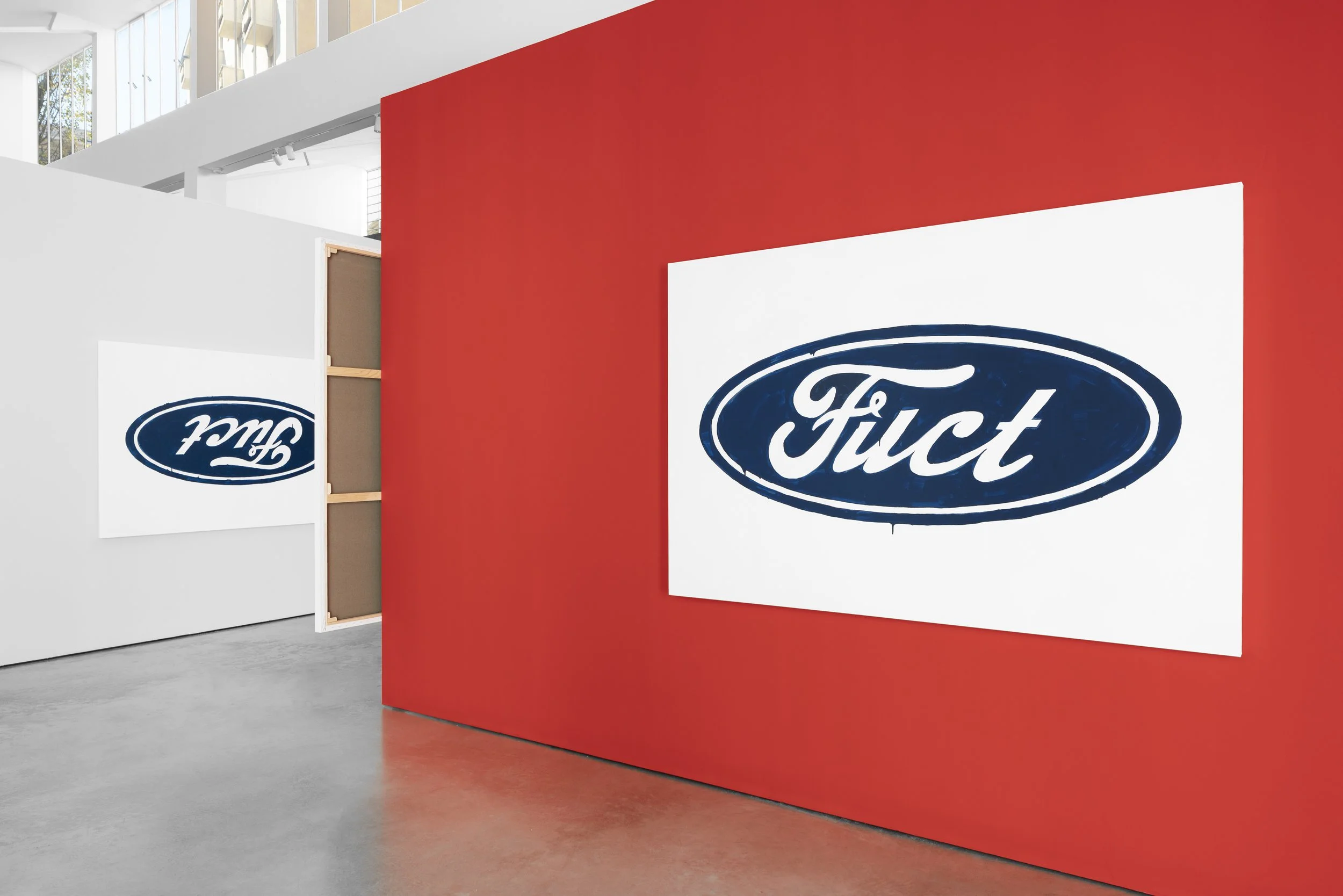
Installation view, Oval Parody, Spazio Maiocchi, Milan, 2022. Twelve acrylic paintings on canvas. Curated by KALEIDOSCOPE.
The Genealogy of Oval Parody
The historical development of Oval Parody is documented through a sequence beginning with the original FUCT oval pencil sketch and continuing through analog production materials, early cultural circulation, painting, printmaking, and exhibition ephemera.
Together, these materials trace the image from its initial conception around 1990–1991 through more than three decades of translation and reuse. Each stage preserves a distinct condition of the work: drawing, enlargement, refinement, mechanical construction, reproduction, cultural circulation, monumental painting, editioned printmaking, and public presentation.
Presented as a continuous genealogy, the sequence establishes Oval Parody not as an isolated series but as the later development of a sustained artistic methodology. The surviving materials demonstrate how a single image changes in meaning, scale, material authority, and cultural function as it moves among paper, mechanical production, apparel, publishing, photography, painting, silkscreen, and exhibition display.
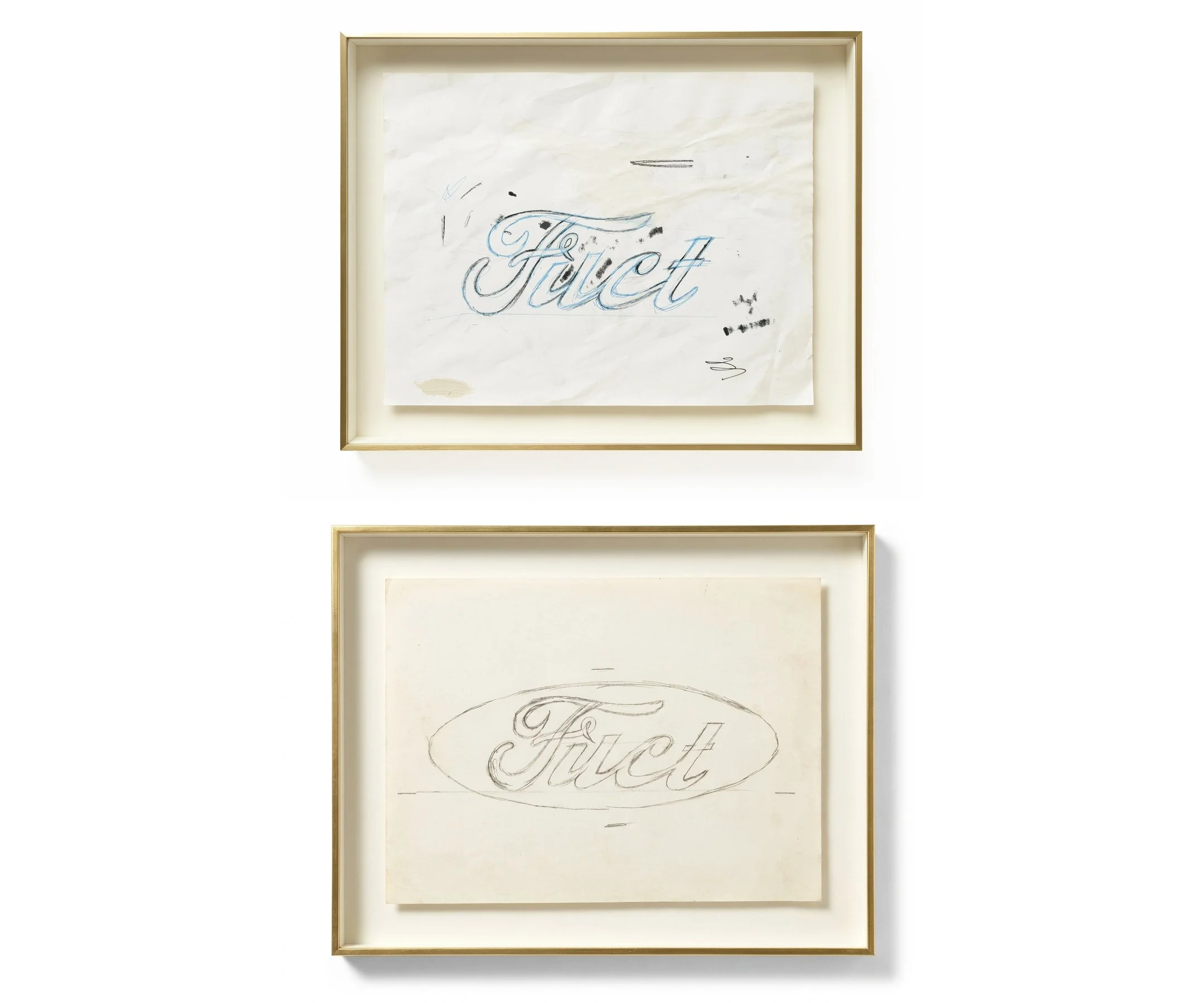
Erik Brunetti, FUCT Oval Parody, Preparatory Drawing and Working Mechanical, c. 1990–1991. Graphite and blue pencil on paper; graphite and mixed studio media on paper, with erasures, corrections, adhesive residue, and production markings. Surviving working documents recording the development of the FUCT oval from hand-rendered letterform to reproducible graphic artwork.
FUCT Oval Parody—Preparatory Drawing & Working Mechanical
The preparatory drawing and working mechanical preserve successive stages in the development of the FUCT oval graphic later revisited in Oval Parody. Executed c. 1990–1991, the two documents record the movement of the image from an exploratory hand-rendered letterform toward the standardized graphic used for reproduction.
The preparatory drawing establishes the oval composition in graphite, retaining construction lines, adjustments to the letterforms, and revisions to the relationship between the wordmark and its enclosing border. The working document above it records a later stage of refinement, with blue pencil, graphite, erasures, correction material, registration marks, and other studio interventions remaining visible on the sheet. Read together, the documents preserve decisions that largely disappear from the finished graphic: changes in proportion and curvature, the adjustment of individual letters, the positioning of the wordmark within the oval, and the progressive stabilization of the image for production.
Brunetti’s translation of the drawing into reproducible artwork proceeded through the analog methods available to his studio at the time. Drawing, Xerox enlargement, light-table tracing, marker rendering, copying, mounting, and hand cutting allowed the image to be repeatedly adjusted while moving toward a production mechanical capable of consistent reproduction. Rather than constituting a single act of transcription, the process required the graphic to be reconstructed across successive physical states, each carrying evidence of the decisions through which the final form emerged.
The survival of these materials gives the later history of the oval an unusually precise documentary point of origin. They precede its circulation through FUCT apparel and printed matter and provide primary evidence for the graphic genealogy subsequently extended through editioned printmaking and Brunetti’s twelve Oval Parody paintings presented at Spazio Maiocchi in 2022. Their significance lies in preserving the physical development of an image whose later circulation largely encountered only its resolved form.
Retained within the FUCT Archive for research, publication, exhibition, and Catalogue Raisonné documentation, the two documents establish material continuity between Brunetti’s early analog production practice and the subsequent manifestations of Oval Parody across more than three decades.
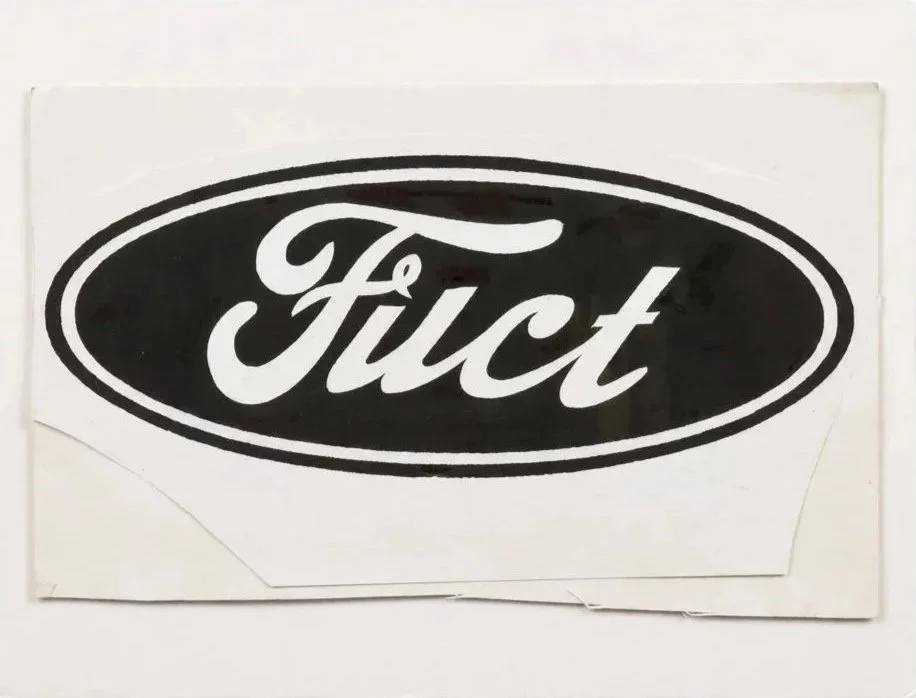
Erik Brunetti, Original FUCT Oval Mechanical, c. 1990–1991. Hand-cut and assembled Xerox mechanical mounted to illustration board. FUCT Archive, Erik Brunetti Foundation for the Arts.
Original FUCT Mechanical
Produced around 1990–1991, the original hand-cut FUCT mechanical converted Brunetti’s pencil drawing into camera-ready graphic artwork.
Constructed through Xerox reproduction, light-table tracing, mounting, positioning, and hand cutting, it preserves the image at the point between initial conception and printed circulation.
Unlike a conventional preparatory drawing, the mechanical functioned as a production instrument. It established the refined proportions, placement, contrast, and edges required for reproduction. Its cut paper, overlapping layers, tonal variation, adhesive mounting, and visible adjustments document the physical decisions through which the graphic acquired its reproducible form.
The mechanical provides direct evidence of Brunetti’s analog production methodology during FUCT’s formative period. It documents a process undertaken before digital design tools allowed images to be enlarged, redrawn, sharpened, and repositioned electronically. The precision of the finished graphic was achieved through repeated copying and direct manipulation of physical materials.
From this source, the oval entered circulation through FUCT apparel, publications, and independent retail and cultural networks during the early 1990s. Its recognition developed through repeated public encounter rather than through a single exhibition or autonomous artwork.
The mechanical was subsequently reproduced in the Rizzoli monograph FUCT and exhibited in Italy. Its relationship to the original pencil sketch, later printed forms, the 2022 working study, and the twelve Milan paintings establishes a continuity of process extending across approximately three decades.
Retained as a cornerstone of the FUCT Archive, the original mechanical supports continuing research, publication, exhibition, and curatorial study. It is preserved as part of the Foundation’s permanent archival record and is not offered for sale.
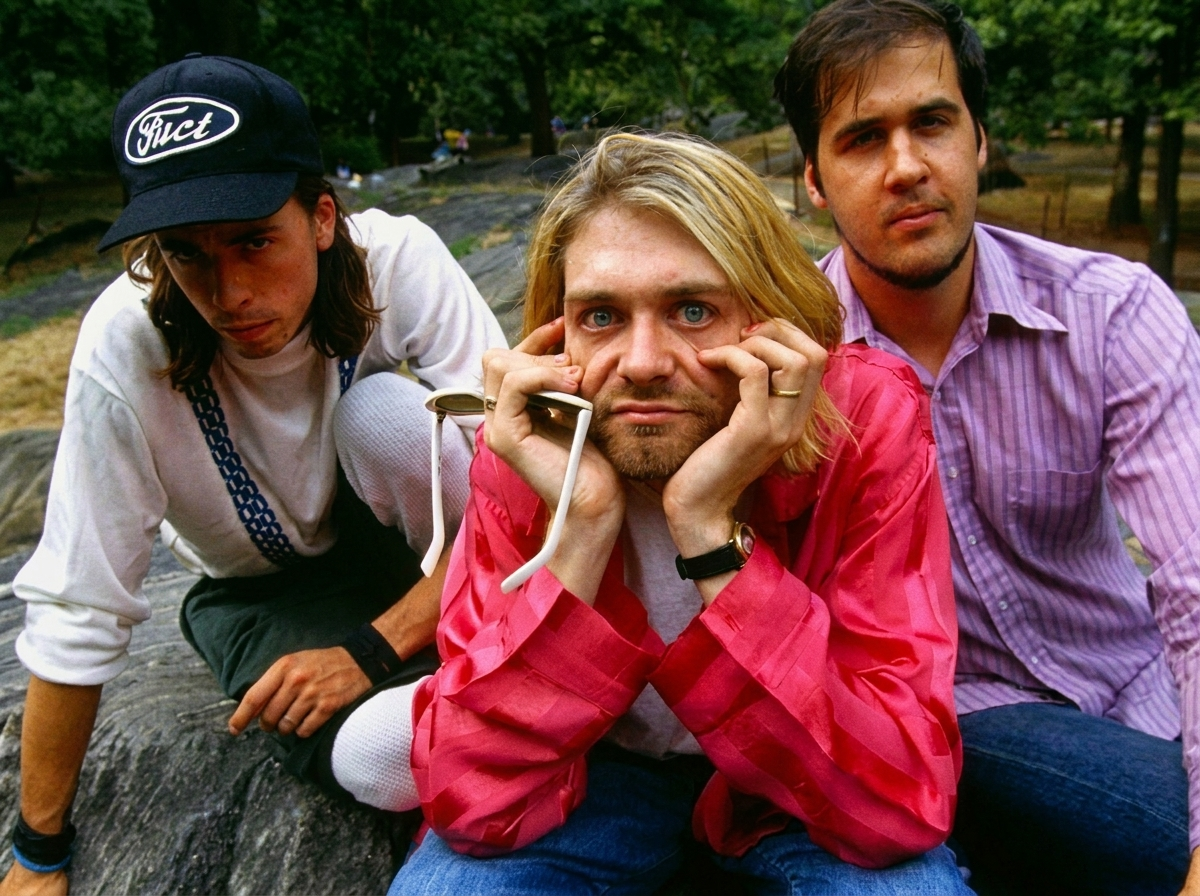
Nirvana in Central Park, New York, July 24, 1993. From left: Dave Grohl, wearing a FUCT oval cap; Kurt Cobain; and Krist Novoselic. Photograph © Hugo Dixon, commissioned by Q. The image documents the early public circulation of Brunetti’s FUCT oval graphic.
Public Circulation—1993
By 1993, the FUCT oval had moved beyond its original function as a production graphic and entered a wider field of cultural circulation.
Distributed through apparel rather than through a conventional exhibition or advertising campaign, the image acquired visibility through the people who chose to wear it and through the photographs and broadcasts that recorded those appearances.
A photograph of Nirvana taken in Central Park on July 24, 1993, documents Dave Grohl wearing a cap bearing the FUCT oval alongside Kurt Cobain and Krist Novoselic. Photographed by Hugo Dixon during a session commissioned by Q, the image places the graphic within the visual history of one of the period’s most widely documented musical groups. Its appearance is incidental rather than promotional: the cap functions as an ordinary article of clothing while carrying the oval into a photograph that would continue to circulate internationally.
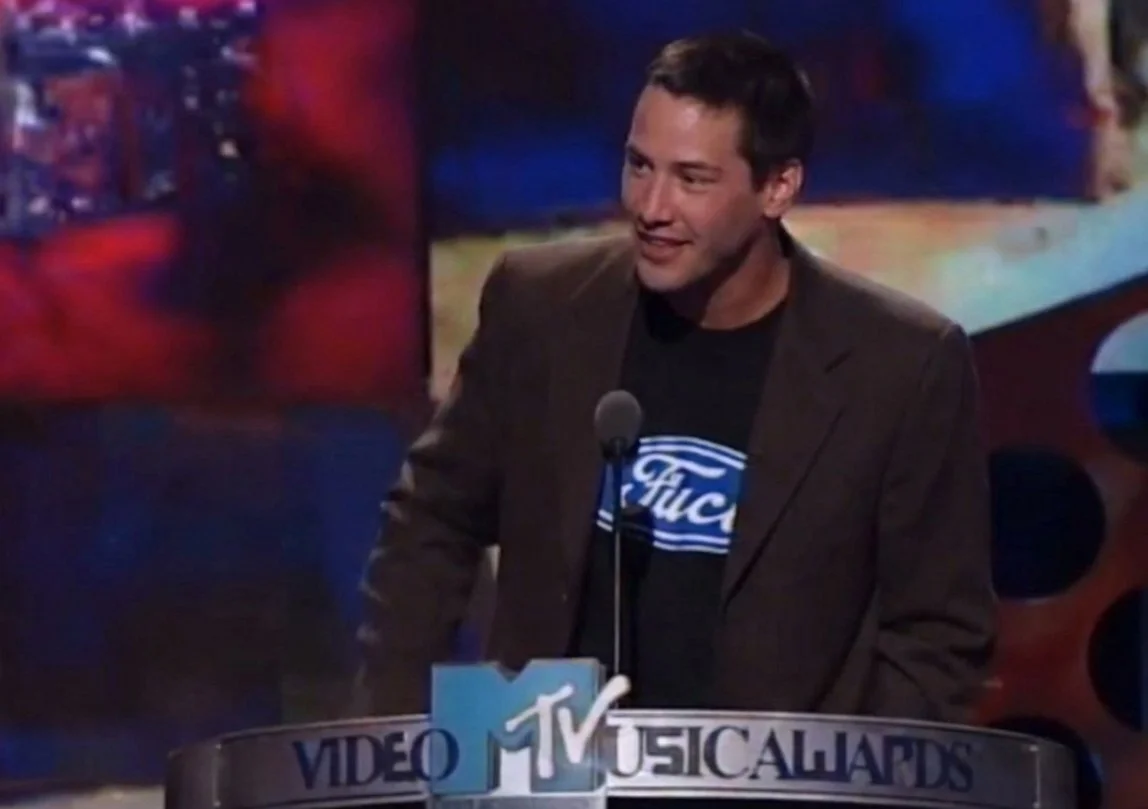
Keanu Reeves presenting at the 1993 MTV Video Music Awards, Los Angeles, September 2, 1993, wearing a FUCT oval T-shirt. Archival broadcast still.
Later that year, Keanu Reeves appeared at the MTV Video Music Awards in Los Angeles wearing a black FUCT oval T-shirt beneath an open blazer. While presenting the awards for Best Female Video and Best Male Video, the graphic remained visible during portions of the live television broadcast. The surviving footage provides a second form of dated evidence, recording the image not through a staged fashion campaign but through mass-media transmission to a national television audience.
Together, the Nirvana photograph and MTV broadcast demonstrate two parallel forms of circulation: the still photograph, repeatedly reproduced through publishing and music media, and the transient televised appearance preserved in archival footage. In both instances, the oval entered public view through apparel and personal use rather than through direct explanation or institutional framing.
These appearances contributed to the image’s cultural recognition before it entered formal printmaking with Richard Duardo in 1997 and decades before Brunetti returned to it as the basis of the Oval Parody paintings. They document an early stage in which the graphic accumulated meaning through wear, photography, broadcast media, and repeated public encounter.
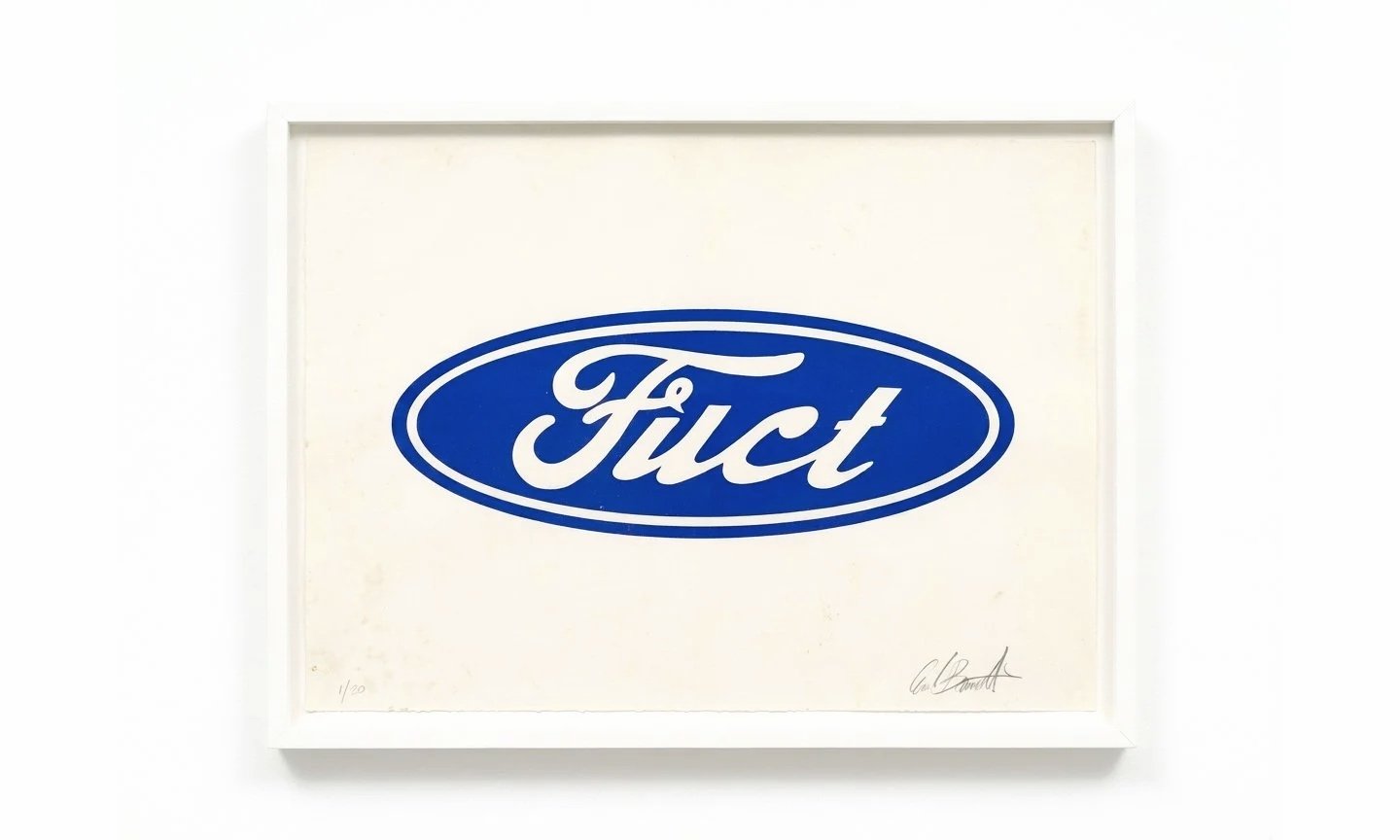
Erik Brunetti, Corporate Oval Parody, 1997. Silkscreen serigraph on Stonehenge Heavyweight 320 paper, 22 × 30 inches. Edition of 30, with three artist’s proofs and three publisher’s proofs. Published by Richard Duardo.
Richard Duardo Edition—1997
In 1997, Brunetti worked with Los Angeles master printer and publisher Richard Duardo to translate the FUCT oval into a formal silkscreen edition.
The project marked a significant change in the image’s material and cultural status. Developed originally as camera-ready artwork for reproduction across apparel and printed matter, the oval was reconfigured as an editioned fine-art print produced within the controlled conventions of professional printmaking.
Titled Corporate Oval Parody, the edition preserved the graphic clarity and reproducible character of the original mechanical while giving the image a newly autonomous physical form. Printed as a silkscreen serigraph on Stonehenge Heavyweight 320 paper, each impression measures 22 × 30 inches and carries Brunetti’s signature at the lower right and the studio chop at the lower left.
The complete edition was limited to 30 signed and numbered impressions, accompanied by three artist’s proofs and three publisher’s proofs. Its restricted structure distinguished the project from the image’s earlier open circulation through clothing, publications, independent retail, photography, and popular media. Rather than functioning as a component within another object, the oval was presented as the primary subject of an individually documented work on paper.
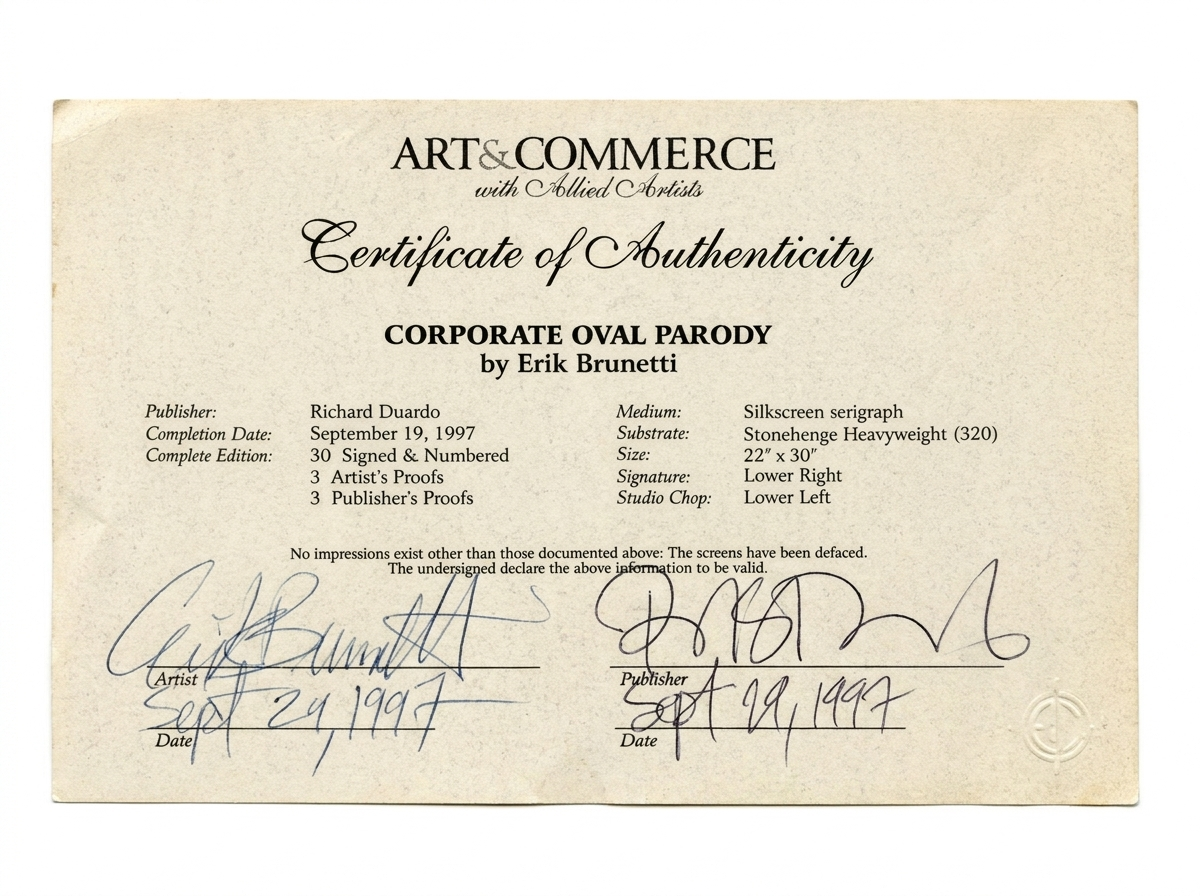
Certificate of Authenticity for Erik Brunetti, Corporate Oval Parody, 1997. Issued by Art & Commerce with Allied Artists and signed by Brunetti and publisher Richard Duardo. The certificate records the silkscreen edition of 30 signed and numbered impressions, three artist’s proofs, and three publisher’s proofs, and confirms that the screens were defaced following completion. FUCT Archive, Erik Brunetti Foundation for the Arts.
The edition was completed on September 19, 1997. Its certificate of authenticity identifies Duardo as publisher and records the edition structure, materials, dimensions, signature placement, and studio chop. It further states that no impressions exist beyond those documented and that the original screens were defaced following production. This establishes a closed edition and provides contemporaneous evidence of the limits imposed upon its reproduction.
The collaboration is an important point in the genealogy of Oval Parody. It formalized the image within fine-art printmaking while preserving its essential relationship to graphic production and mechanical repetition. The edition demonstrates that Brunetti’s movement between commercial imagery and autonomous art objects was already materially established by the late 1990s, well before his return to the oval as the basis of the twelve monumental paintings presented in Milan in 2022.
The Duardo edition also provides a direct historical precedent for the large-format four-color silkscreen produced with Brand X Editions in 2025. Separated by twenty-eight years, the two editions represent distinct moments in the image’s development: the first formalized a graphic already circulating through FUCT and popular culture; the second returned the image to print after its transformation through painting, monumental scale, and institutional exhibition.
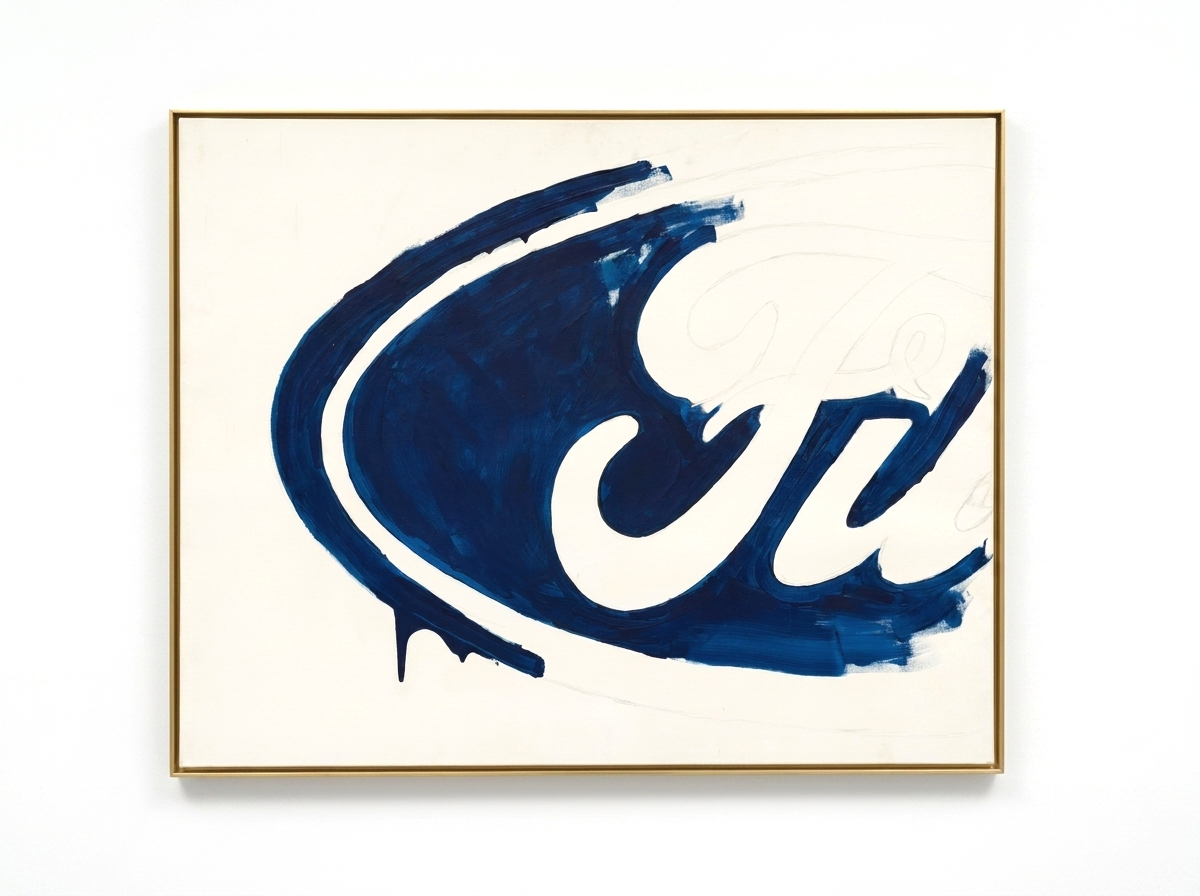
Erik Brunetti, Oval Parody Working Mechanical, 2022. Graphite and acrylic on canvas, 48 × 36 inches. Collection of the Erik Brunetti Foundation for the Arts.
Oval Parody Working Mechanical
Created in preparation for the 2022 paintings, the Oval Parody Working Mechanical records the process through which the original graphic was translated into a monumental painted format.
Executed in graphite and acrylic on canvas, the 48 × 36-inch work occupies an intermediate position between production study and autonomous painting. The visible graphite outlines establish proportion, curvature, and letter placement, while areas of dark paint test density, edge, and the relationship between positive and negative space. Unpainted passages, revisions, brushwork, and incomplete contours preserve the sequence of decisions that would be resolved in the finished canvases.
Rather than presenting the image as a fixed and mechanically consistent emblem, the study exposes the adjustments required to reconstruct it by hand at a larger scale. It demonstrates how a graphic designed for reproduction was converted into a painted object while retaining the recognizable structure of its analog source.
Presented publicly by the Foundation as part of the project’s archival record, the working mechanical forms the material link between the original 1990s FUCT mechanical and the twelve paintings exhibited in Milan. It is retained for research, publication, exhibition, and curatorial study.
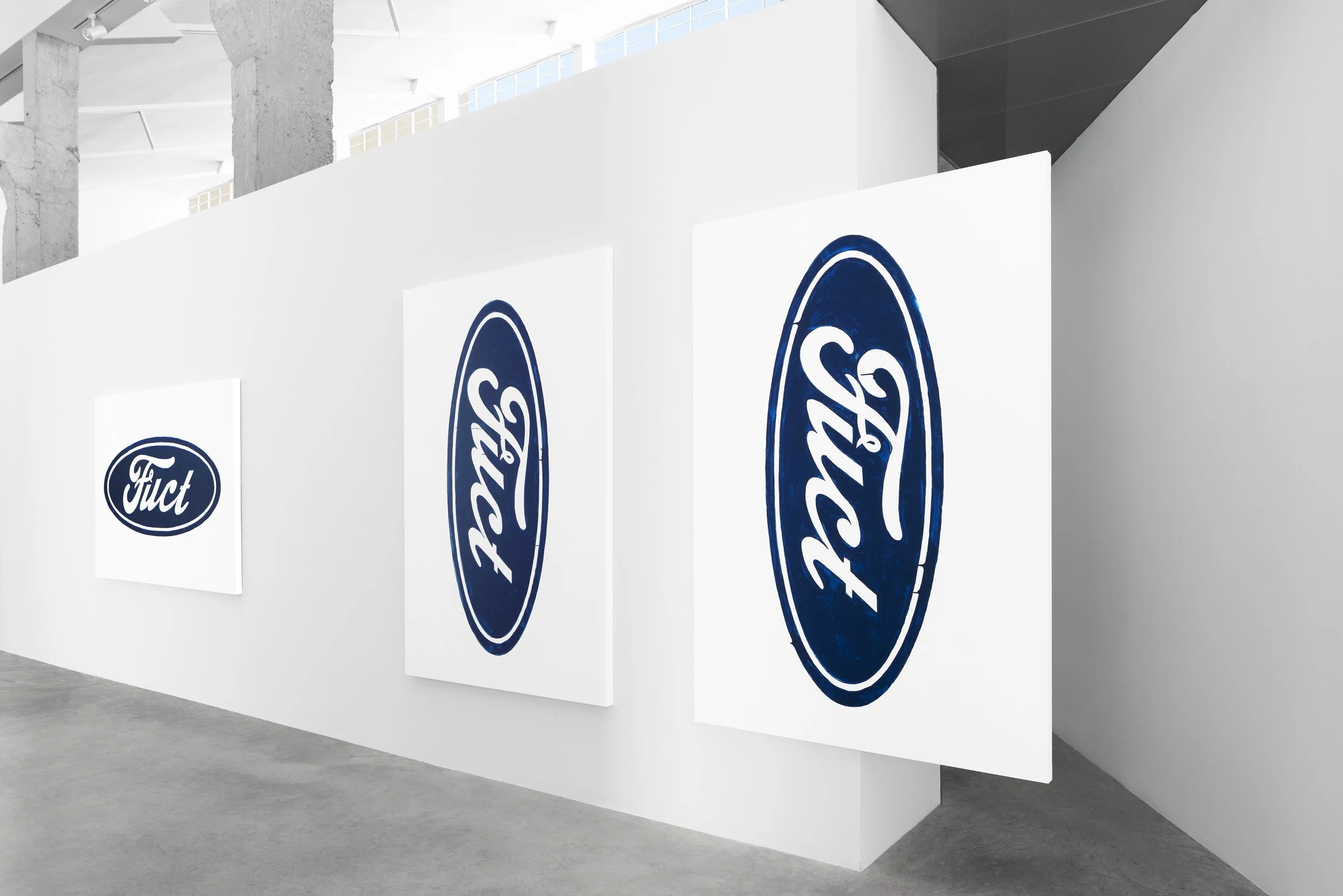
Installation view, Oval Parody, Spazio Maiocchi, Milan, 2022. Twelve acrylic paintings on canvas. Curated by KALEIDOSCOPE. Photograph courtesy of the artist and Spazio Maiocchi.
Twelve Paintings
The twelve acrylic paintings on canvas formed the principal body of the 2022 Milan presentation at Spazio Maiocchi.
Brunetti’s return to the oval motif transformed an image developed for mechanical reproduction into a sequence of singular painted objects. Enlarged to architectural scale, the graphic acquired a physical presence distinct from its earlier circulation through apparel and printed matter.
The transfer into paint did not eliminate the image’s reproducible character. Instead, it introduced material variation into a form associated with graphic consistency. Differences in color, surface, proportion, edge, density, and execution remain visible across the twelve canvases, disrupting the apparent uniformity of the shared image.
The paintings examine how repetition produces authority and how familiar symbols persist after moving beyond their original circumstances. Each work maintains the recognizable oval structure while registering the evidence of individual production. Together, the series occupies a space between graphic system and painting, mechanical image and handmade object, commercial circulation and institutional presentation.
Presented as a complete sequence in Milan, the twelve paintings established Oval Parody as a distinct body of work while preserving its relationship to Brunetti’s earlier graphic practice.
Ten paintings from the Milan presentation are held by the Erik Brunetti Foundation for the Arts. Two are held in private collections. Selected works may be considered for institutional loan, scholarly research, and curatorial presentation.
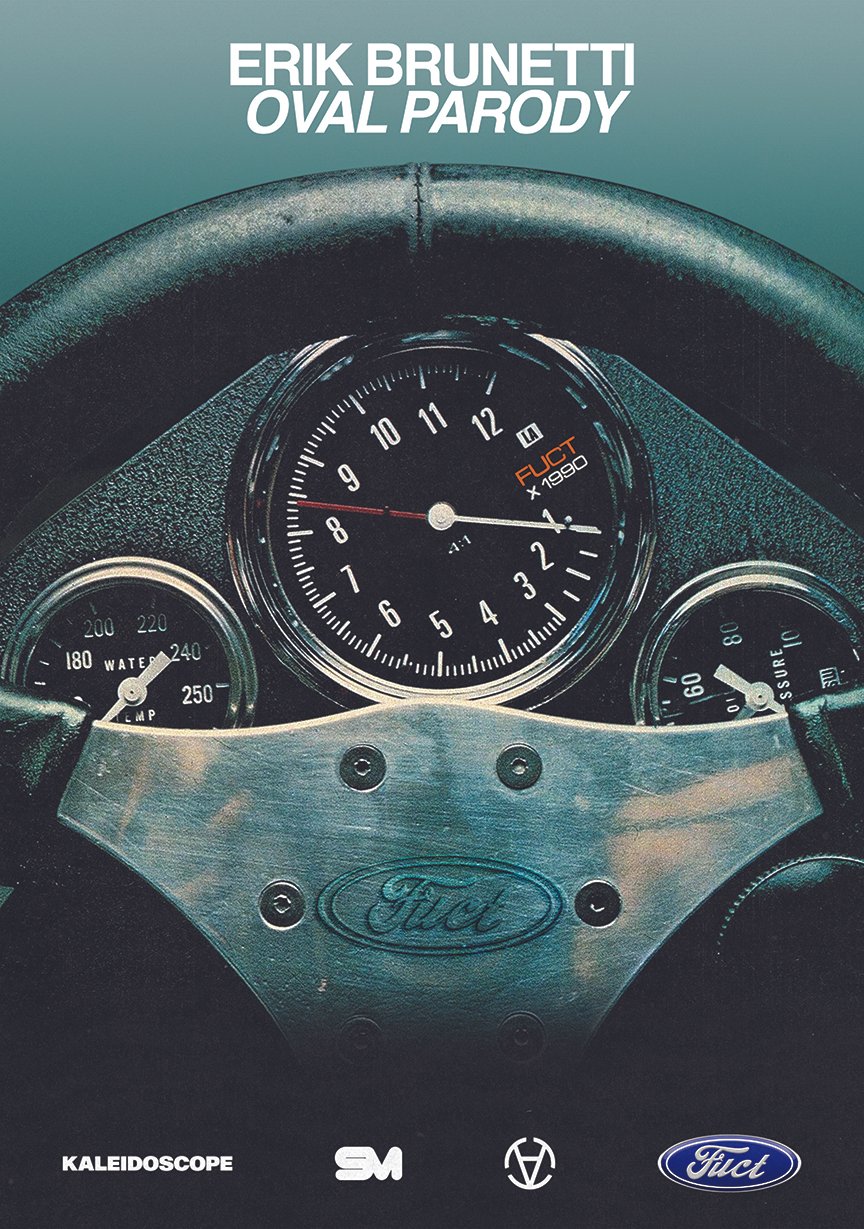
Original Oval Parody exhibition poster, 2022. Offset print on paper, produced for Erik Brunetti’s solo exhibition at Spazio Maiocchi, Milan, curated by KALEIDOSCOPE. Exhibition Archive, Erik Brunetti Foundation for the Arts.
Original Spazio Maiocchi Exhibition Poster
The original offset poster was produced in connection with the 2022 presentation of Oval Parody at Spazio Maiocchi in Milan.
Designed to announce and extend the public identity of the exhibition, it translated the project’s graphic language into a form intended for public circulation.
Preserved examples form part of the exhibition archive and document the relationship among the paintings, their institutional presentation, and the visual material through which the exhibition was communicated. The poster is identified in Foundation records as the Original 2022 Spazio Maiocchi Exhibition Poster.
Exhibition
2022
Oval Parody
Spazio Maiocchi, Milan, Italy
Solo exhibition curated by KALEIDOSCOPE
Twelve acrylic paintings on canvas, publication, and billboard installation.
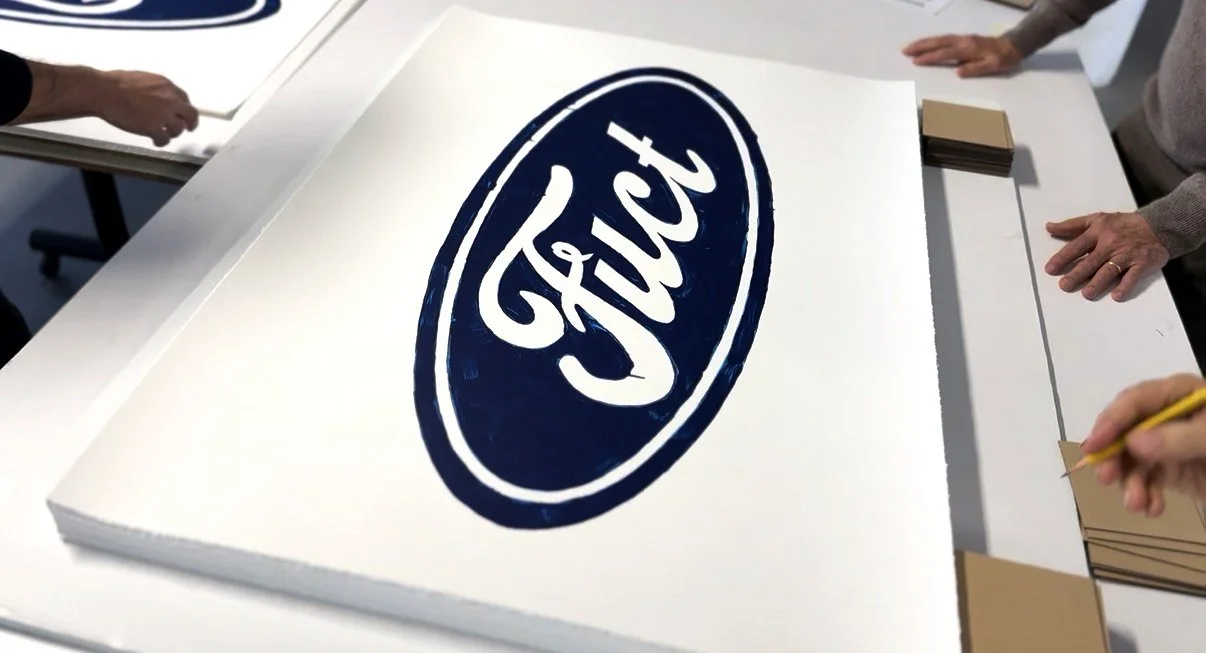
Production view of Erik Brunetti’s FUCT (Oval Parody), 2025, at Brand X Editions. Four-color silkscreen on Stonehenge White 250 gsm. Printer: Alex Mercedes; chromist: Sofia Varieschi.
Brand X Edition
The Brand X edition returns the image from painting to mechanical reproduction. Following its transformation from a 1990s analog graphic into the twelve paintings presented in Milan, Oval Parody was reconfigured as a large-format four-color silkscreen.
This movement is not simply reproductive. The edition preserves the scale and visual authority developed through the paintings while returning the image to controlled circulation through print. In doing so, it reconnects the project with Brunetti’s earlier use of reproducible media while retaining the material and historical context accumulated through the 2022 exhibition.
Produced in collaboration with Brand X Editions, the print was developed through a process of color separation, proofing, adjustment, and artist approval. Alex Mercedes served as printer and Sofia Varieschi as chromist. Production records document the technical decisions through which the image was translated into its final printed form.
Artist: Erik Brunetti
Title:FUCT (Oval Parody)
Date: 2025
Process: Four-color silkscreen
Paper: Stonehenge White, 250 gsm
Image size: 42 × 28.5 inches
Paper size: 42 × 28.5 inches
Edition: 65 numbered impressions, with artist, printer, and museum proofs
Printer: Alex Mercedes
Chromist: Sofia Varieschi
Publisher: Brand X Editions
Signature: Lower right recto
Chop: Lower right recto
Each numbered impression is signed and documented within the edition record. The separately designated proofs preserve the contributions of the artist, printer, publisher, and participating institutions within the complete structure of the edition.
An impression of FUCT (Oval Parody) is scheduled for inclusion in Brand X Editions’ forthcoming archive donation to the Philadelphia Museum of Art. Brand X Editions is also seeking to include an impression in a separate donation being prepared for the Dallas Museum of Art. Both proposed transfers are expected by the end of 2026 and remain subject to delivery, institutional review, and formal accession. The Foundation will update the edition record as each placement is confirmed.
Through the Brand X edition, the image enters a new phase of circulation while remaining materially and historically connected to the original FUCT mechanical, the 2022 working mechanical, and the twelve Milan paintings.
Archival Continuity
The Foundation documents Oval Parody as a connected material and historical record rather than as a group of unrelated objects.
The original FUCT oval pencil sketch, analog production process, hand-cut mechanical, 1993 Duardo edition, evidence of early cultural circulation, 2022 working mechanical, twelve Milan paintings, exhibition publication and poster, Brand X edition, and related records preserve successive stages in the image’s conception, construction, reproduction, circulation, translation, and public presentation.
This continuity supports attribution, provenance, exhibition research, publication, and preparation of the Catalogue Raisonné. It also allows the project to be studied across multiple fields—including drawing, graphic production, apparel, photography, painting, printmaking, publishing, and institutional display—without separating its later forms from their historical origin.
Institutional Access
Works and records associated with Oval Parody may be available for institutional loan, scholarly research, reproduction, publication, and curatorial review subject to Foundation policy.
Curatorial & institutional inquiries:
archive@erikbrunettifoundation.org